 Blurnft
 NFT Trading, Aggregation and Borrowing Costs
Blurnft combines Ethereum NFT trading, aggregated listings and portfolio tools for buying and selling digital collectibles. Buyers can sweep several listings, while sellers can publish asking prices or accept available bids. Blend adds borrowing against supported NFTs and purchases using borrowed funds. Borrowing creates a repayment obligation secured by the NFT. Marketplace fees, creator royalties and network gas each affect costs; a financed purchase also carries collateral risk and any interest due under its loan terms.
Jump to a section
Aggregated listings widen the available choices, while purchase prices, gas costs and applicable royalties shape trading costs, with loan terms affecting financed purchases.
Buying, Selling and Borrowing Through Connected Tools
An outright purchase uses an available listing, while a sale can attract a listing buyer or take an eligible standing bid. Its aggregation tools also bring listings from multiple marketplaces into the trading interface. Sweeping groups several selected NFTs for purchase, reducing the need to handle each listing separately. Availability still rests on valid orders and the assets sellers can transfer.
Borrowing introduces a different relationship: an NFT supports a loan, and the lender provides funds under agreed terms. Blend connects this financing function with the broader trading interface. Portfolio analytics help organize holdings and market information across these activities. A purchase price, an outstanding loan balance and a collection’s floor price describe different things, even when they concern the same NFT.
Aggregation and the Orders Behind a Trade
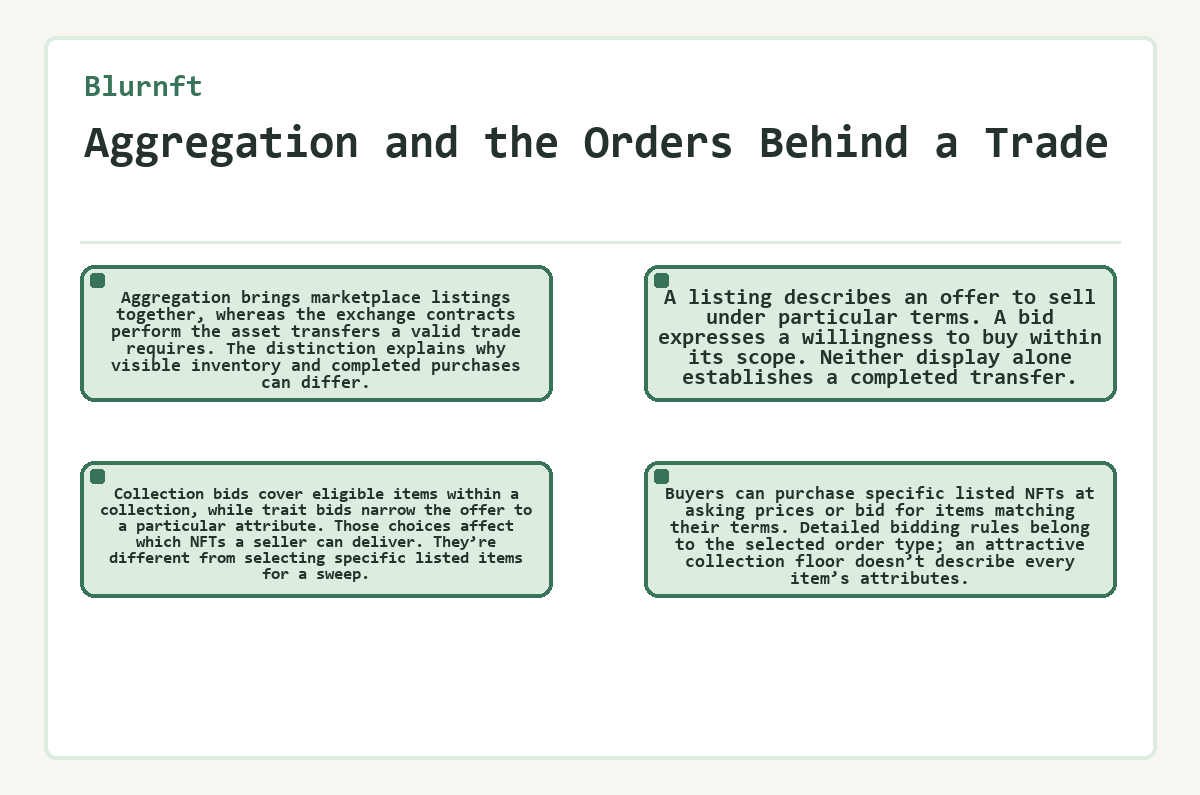
Aggregation brings marketplace listings together, whereas the exchange contracts perform the asset transfers a valid trade requires. The distinction explains why visible inventory and completed purchases can differ. A listing describes an offer to sell under particular terms. A bid expresses a willingness to buy within its scope. Neither display alone establishes a completed transfer.
Collection bids cover eligible items within a collection, while trait bids narrow the offer to a particular attribute. Those choices affect which NFTs a seller can deliver. They’re different from selecting specific listed items for a sweep. Buyers can purchase specific listed NFTs at asking prices or bid for items matching their terms. Detailed bidding rules belong to the selected order type; an attractive collection floor doesn’t describe every item’s attributes.
Does a Zero Marketplace Fee Make Trading Free?
A zero marketplace fee removes that marketplace charge, while NFT purchase payments, applicable creator royalties and Ethereum execution costs remain separate costs.
Marketplace Charges and Royalties
The Blur marketplace advertises a 0% marketplace fee for its own trading service. That figure doesn’t describe every expense in an aggregated transaction. The order’s settlement terms determine any applicable marketplace charge and creator payment. Buyers and sellers therefore need the actual payment breakdown, including who pays each component.
Ethereum Execution Costs
Ethereum transaction fees are paid in ETH. Gas measures computation, and the execution charge depends on gas consumed and the effective gas price. Network demand influences that price. A larger or more complex contract interaction can consume different amounts of gas, so the NFT’s asking price doesn’t determine its network fee.
Gross sale value and net proceeds can differ after applicable deductions. Financed positions add an outstanding debt balance to that calculation. These components affect different recipients and obligations; combining them into a single advertised fee hides the amounts each participant pays or receives.
A Sweep Purchase From Selection to Settlement
A sweep groups selected listings for purchase, but the buyer acquires only the NFTs successfully transferred under valid order terms. For an outright purchase, the purchase payment and network gas create separate funding requirements.
| Purchase Stage | Information Used | Practical Effect | Purchase Requirements and Limits |
|---|---|---|---|
| Collection Selection | Collection contract and item information | Identifies the intended NFTs | A matching collection name doesn’t establish contract identity |
| Listing Review | Available listings and asking terms | Identifies purchase candidates | Orders must remain valid for settlement |
| Sweep Selection | The chosen listed items | Defines the proposed purchase set | Each purchased item needs an executable order |
| Cost Review | Purchase payment and estimated gas | Establishes the funding requirement | Available funds must cover payment and network execution |
| Wallet Authorization | The purchase transaction details | Authorizes the purchase instruction | Signing must match the intended action and amount |
| Network Execution | The signed purchase transaction | Runs the purchase contracts | Block inclusion and successful execution are required |
| Ownership Record | Transaction receipt and NFT transfers | Identifies successfully acquired items | A transaction hash alone doesn’t prove NFT ownership |
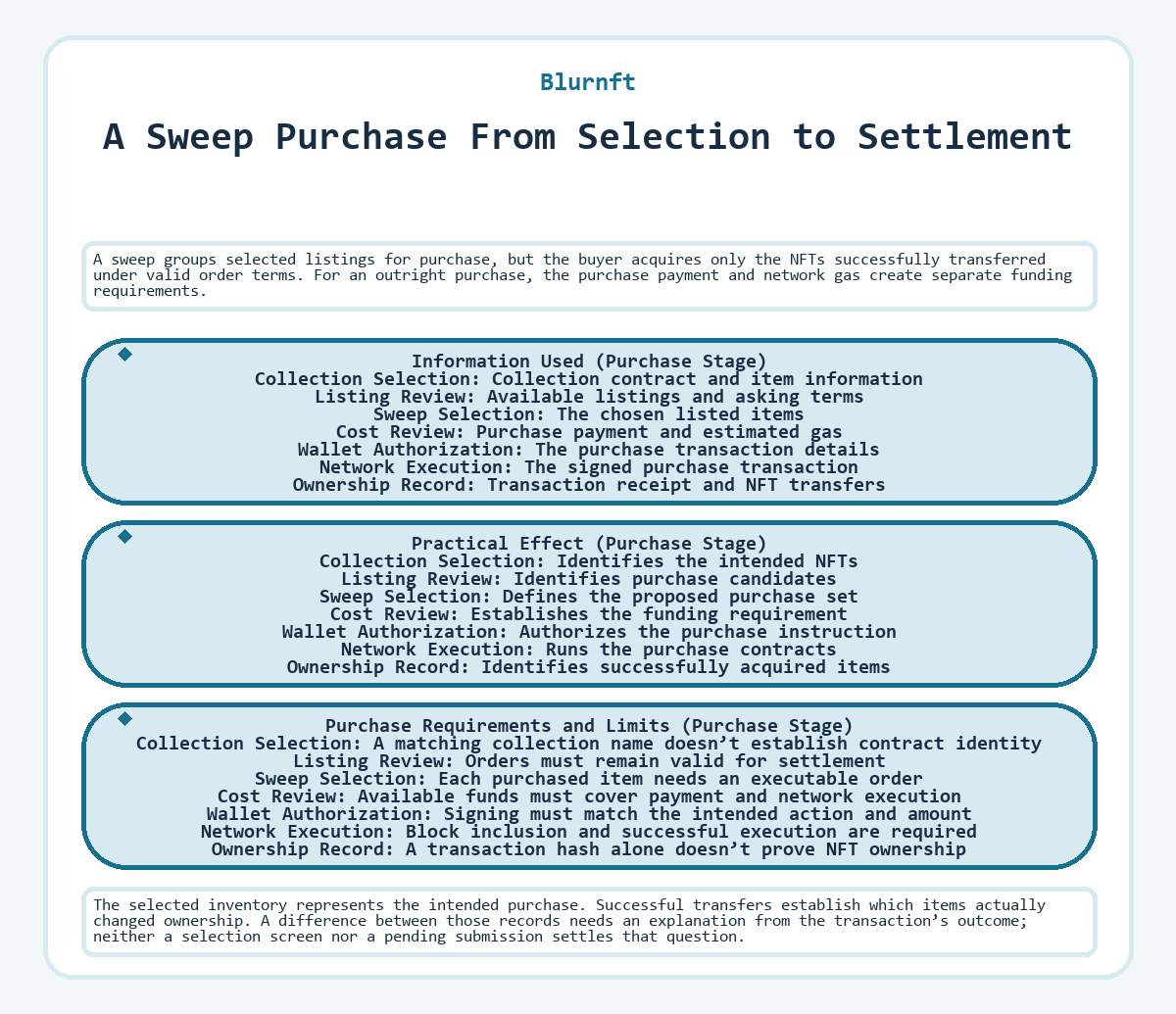
A Sweep Purchase From Selection to Settlement
A sweep groups selected listings for purchase, but the buyer acquires only the NFTs successfully transferred under valid order terms. For an outright purchase, the purchase payment and network gas create separate funding requirements.
- Information Used (Purchase Stage) Collection Selection: Collection contract and item information Listing Review: Available listings and asking terms Sweep Selection: The chosen listed items Cost Review: Purchase payment and estimated gas Wallet Authorization: The purchase transaction details Network Execution: The signed purchase transaction Ownership Record: Transaction receipt and NFT transfers
- Practical Effect (Purchase Stage) Collection Selection: Identifies the intended NFTs Listing Review: Identifies purchase candidates Sweep Selection: Defines the proposed purchase set Cost Review: Establishes the funding requirement Wallet Authorization: Authorizes the purchase instruction Network Execution: Runs the purchase contracts Ownership Record: Identifies successfully acquired items
- Purchase Requirements and Limits (Purchase Stage) Collection Selection: A matching collection name doesn’t establish contract identity Listing Review: Orders must remain valid for settlement Sweep Selection: Each purchased item needs an executable order Cost Review: Available funds must cover payment and network execution Wallet Authorization: Signing must match the intended action and amount Network Execution: Block inclusion and successful execution are required Ownership Record: A transaction hash alone doesn’t prove NFT ownership
The selected inventory represents the intended purchase. Successful transfers establish which items actually changed ownership. A difference between those records needs an explanation from the transaction’s outcome; neither a selection screen nor a pending submission settles that question.
The selected inventory represents the intended purchase. Successful transfers establish which items actually changed ownership. A difference between those records needs an explanation from the transaction’s outcome; neither a selection screen nor a pending submission settles that question.
Collection Prices and Portfolio Signals
Collection metrics help distinguish asking prices, completed sales and available bids, each of which answers a different question about the market. Floor price describes the lowest listed price in the relevant collection view. Trading volume records activity over its displayed period. Owner counts show how many wallets hold items in the collection. None of these metrics sets the price every holder can obtain.
Item information adds another layer through traits, rarity labels and previous sale information. A particular NFT can differ substantially from the collection’s cheapest listing. Portfolio analytics bring holdings into this market context, while reveal tools focus attention on newly visible item attributes. Speed affects access to information, but a rarity label doesn’t create a willing buyer. The available bid and the particular item’s eligibility remain separate considerations.
Listing Prices and Available Sale Proceeds
A listing sets asking terms for an NFT, while an eligible bid provides a potential sale on terms a buyer already offered. A higher asking price doesn’t guarantee a sale. Listing tools can organize pricing around collection floors or trait floors and support laddered prices across holdings. These tools arrange offers; they don’t turn the listed amounts into settled proceeds. Borrowed positions also carry debt the sale must account for.
Creator Royalties Within the Sale
Creator royalties direct part of a qualifying sale to a creator or rights holder, separately from marketplace charges and network execution fees. The applicable collection rules and settlement terms determine the payment. A displayed royalty preference doesn’t establish an identical outcome for every listing or bid. Royalty enforcement has also changed through marketplace policies, making a universal percentage unsuitable for describing all trading paths.
The collection’s royalty amount matters directly to net proceeds when the sale deducts that payment. Different settlement arrangements can assign costs differently, so a buyer’s total and a seller’s receipt needn’t match. Token ownership and creator earnings also describe separate rights: acquiring an NFT doesn’t make its buyer the recipient of future creator royalties. The recipient follows the relevant royalty arrangement.
Blend Borrowing and Financed NFT Purchases
Blend supports NFT-backed lending and purchases financed with borrowed funds, connecting collateral, loan terms and trading decisions within the same ecosystem.
Borrowing Against an Existing NFT
An existing NFT can serve as collateral for a compatible loan offer. The offer defines the available principal and interest terms. Protocol capability and interface availability have different scopes: the broad lending design doesn’t mean every collection has an available loan offer. Borrowing depends on supported collateral and a lender willing to fund the position.
Buying With Borrowed Funds
Buy Now Pay Later uses a loan to help finance an NFT purchase. The borrow balance accrues any interest due under the agreed terms. Repaying the outstanding debt at any time releases the collateral from the loan obligation. A sale can also repay the borrowing balance from its proceeds, with the remaining amount determined by the sale and debt. Lower initial funding therefore comes with a continuing liability tied to the NFT.
Refinancing and Collateral Loss
A Blend lender can trigger a refinancing auction. The protocol seeks another lender to take over the debt. If the debt remains unpaid and no lender takes over before the auction ends, the original lender can take possession of the collateral. A loan’s lack of a fixed expiry doesn’t remove this exit mechanism. Refinancing can also change interest terms, so the original rate doesn’t necessarily govern the position forever.
A collection floor supplies market context, while refinancing depends on a willing lender if the borrower doesn’t repay. Blend’s core design doesn’t require a price oracle to trigger liquidation. Falling collateral value can influence lender decisions without creating a universal floor-price liquidation threshold. The auction rules and debt terms govern the position’s specific exposure.
Wallet Permissions and Public Ownership
Wallet access connects an address to trading functions, while signed instructions and contract permissions determine what actions can move its assets on Ethereum. A connection, an order signature and an asset approval perform different jobs. An approval can authorize another address to transfer tokens within its scope. Reviewing that scope matters when a trading contract needs permission to handle NFTs.
NFT ownership records and on-chain transfers are publicly visible. Portfolio information tied to a wallet can therefore reveal holdings and trading activity without access to its private keys. Connecting another address changes which holdings the interface represents; it doesn’t hide the original address’s history.
Authorizing a transaction doesn’t require sharing a private key with the marketplace. Entering a recovery phrase into a marketplace form gives away control the trading interaction doesn’t require. Transaction details should identify the intended contract action and payment, while approval requests should identify the assets and operator they cover.
BLUR Voting Power and Protocol Governance
BLUR is an ERC-20 governance token whose delegated voting power participates in decisions affecting the marketplace and Blend lending protocols. Token balances need delegation to register voting power. A holder can delegate to their own address or another representative.
Governance covers protocol parameters and treasury decisions within its authorized powers. Marketplace upgrades and royalty policy also involve the relevant committee responsibilities. An idea on a discussion forum doesn’t itself change a contract parameter. Proposed rules, adopted decisions and executed changes describe different stages. Voting power doesn’t establish a fixed trading return or a claim to an individual NFT’s sale proceeds.
Reward Seasons and Their Time Limits
Blur’s reward programmes have used season-specific rules for bidding, listing and lending, so their incentives belong to the period each programme defines. Points don’t eliminate an accepted bid’s purchase obligation or a borrower’s debt.
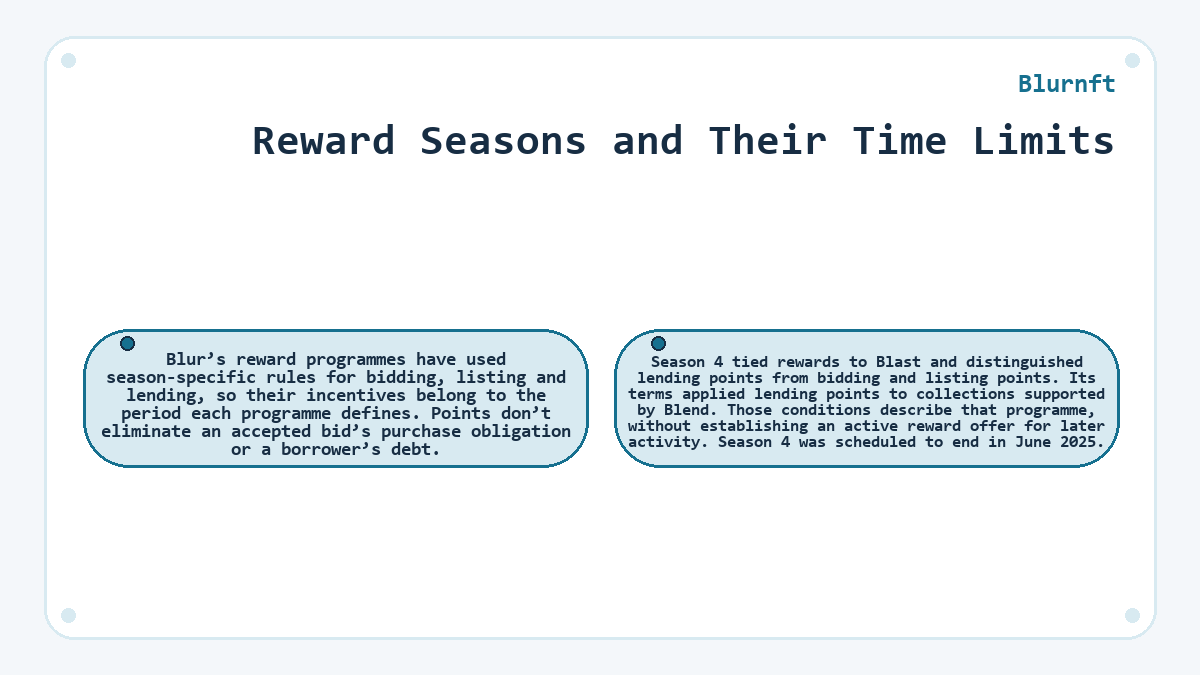
Season 4 tied rewards to Blast and distinguished lending points from bidding and listing points. Its terms applied lending points to collections supported by Blend. Those conditions describe that programme, without establishing an active reward offer for later activity. Season 4 was scheduled to end in June 2025.
Practical questions
What Happens If a Blurnft Purchase Transaction Reverts?
A reverted transaction doesn’t complete the NFT purchase, but an included transaction still charges for the computation it used. The transaction’s failure status and gas charge describe different outcomes. A transaction rejected before block inclusion incurs no on-chain execution fee.
Does Disconnecting a Wallet Remove Its NFT Approvals?
Disconnecting a wallet from the interface doesn’t revoke permissions stored in NFT contracts. For ERC-721 NFTs, an operator approval can cover all tokens the approving address holds in that collection. Removing that permission requires a contract action to revoke it; closing the browser connection doesn’t perform that action.
Why Can an NFT’s Traits Change After Purchase?
An NFT’s displayed traits can change when its collection uses mutable metadata. Trait bidding checks the relevant attribute when a seller attempts to fill the bid, but a collection can change metadata afterward. That later change can alter the displayed trait without changing the token’s identity or reversing its purchase.
How Long Can an NFT Purchase Remain Pending?
An NFT purchase awaiting block inclusion has no guaranteed confirmation time. Network demand and fee settings influence when a validator includes it. A transaction hash identifies the transaction, while a successful execution status and the relevant NFT transfers establish the purchase outcome.
Can I Vote With BLUR Held in a Custodial Exchange Account?
An exchange’s internal BLUR balance doesn’t itself register delegated voting power for your wallet address. Governance uses delegation attached to tokens on-chain. Any participation through a custodian depends on how that provider handles custody and delegation, rather than the balance displayed in its account interface.
What Does a Collection Contract Address Identify?
A collection contract address identifies the token contract, while an ERC-721 token ID identifies an individual NFT within it. Both matter when distinguishing one item from another. Collection names and symbols can repeat across contracts, so a matching label doesn’t establish that two listings concern the same asset.
Are NFT Royalties Enforced by ERC-2981 Alone?
ERC-2981 communicates a royalty recipient and amount but doesn’t itself enforce the payment. Settlement implementations determine whether and how they pay it. The standard therefore can’t establish a universal royalty outcome across marketplaces, and a collection’s royalty information alone doesn’t prove a particular sale paid that amount.
Will All Gas Reserved by My Wallet Be Spent?
A transaction normally pays for the gas it actually consumes, rather than automatically spending its entire gas limit. A wallet’s maximum estimate can therefore exceed the final network charge. Running out of gas during execution is different: it causes failure while consuming the gas provided for that execution.