 Blurnft
Blurnft royalties: Creator Fees and Collection Filters
Blurnft royalties reach the designated creator recipient when a resale settles with a creator payment in its fee terms. Full-rate enforcement depends on the collection’s restrictions and the marketplace policy governing that sale. Blur’s February 2023 framework distinguished a minimum creator fee from the full collection rate. A preferred royalty setting alone doesn’t establish the amount paid.
Creator royalties, marketplace charges and network gas serve different purposes. A resale can include a creator payment even when the marketplace charges no platform fee. Collection bidding adds another distinction: an available bid hasn’t yet generated a settled sale.
Creator Payments on Listings and Accepted Bids
Creator payments on Blur attach to executed NFT resales, including listing purchases and eligible bid acceptances, while marketplace charges follow their own fee terms. The seller receives the remaining sale proceeds under the order’s settlement terms. An unfilled listing or bid hasn’t generated that resale payment.
Requested Rates and Seller Proceeds
A collection’s requested royalty names its preferred creator share, while a minimum sets a payment floor within a particular marketplace policy. Full royalties mean the entire configured creator percentage. They don’t mean the creator receives all sale proceeds.
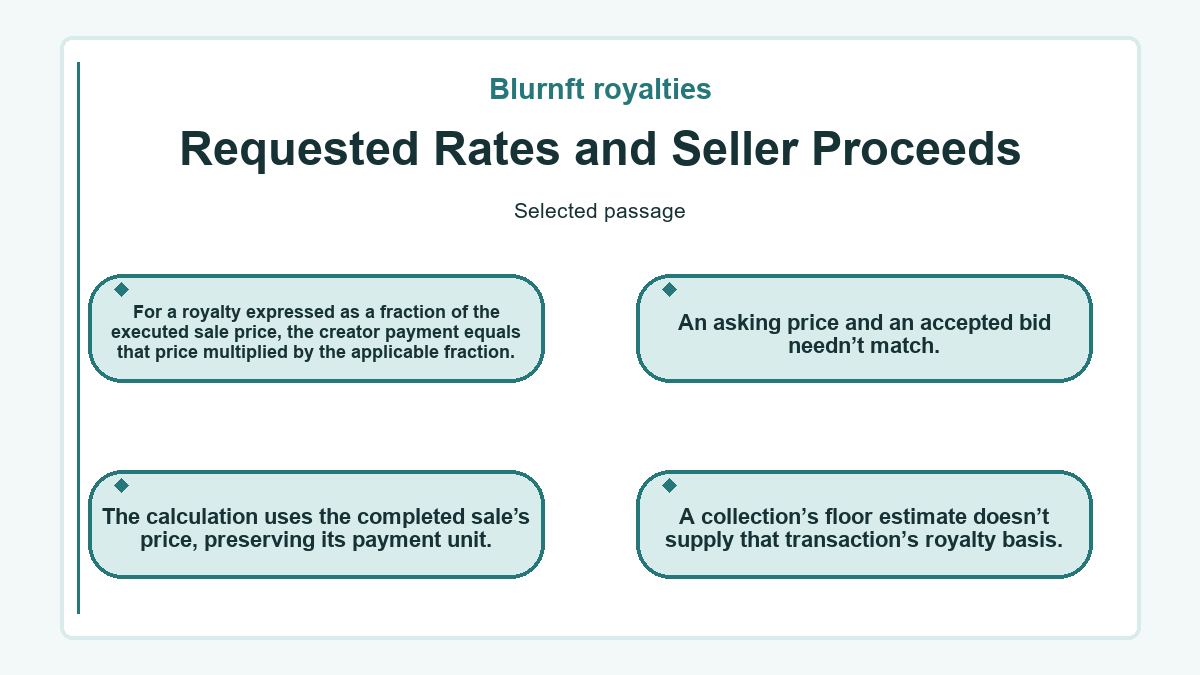
For a royalty expressed as a fraction of the executed sale price, the creator payment equals that price multiplied by the applicable fraction. An asking price and an accepted bid needn’t match. The calculation uses the completed sale’s price, preserving its payment unit. A collection’s floor estimate doesn’t supply that transaction’s royalty basis.
In Blur’s original exchange contract, fee entries paired a recipient with a rate. The contract deducted the combined fee amount from the sale price and transferred the remainder to the seller.
A fee’s label doesn’t identify its beneficiary. Creator payments go to designated royalty recipients, while a protocol payment goes to its configured protocol recipient. Gas has a separate basis. Subtracting an estimated network cost from a creator payment mixes execution expense with the royalty itself.
Changing the payable creator rate changes the creator share even if the sale price stays fixed. A higher share leaves less for the seller when the fee comes from gross proceeds. A minimum-rate payment can therefore settle correctly while remaining below the collection’s requested full rate.
When Did Blur Enforce Full Royalties Under Its 2023 Policy?
Blur’s February 15, 2023 framework enforced full creator royalties for collections blocking trading on OpenSea. Under that configuration, the collection could earn its full rate on Blur while losing OpenSea as a trading route.
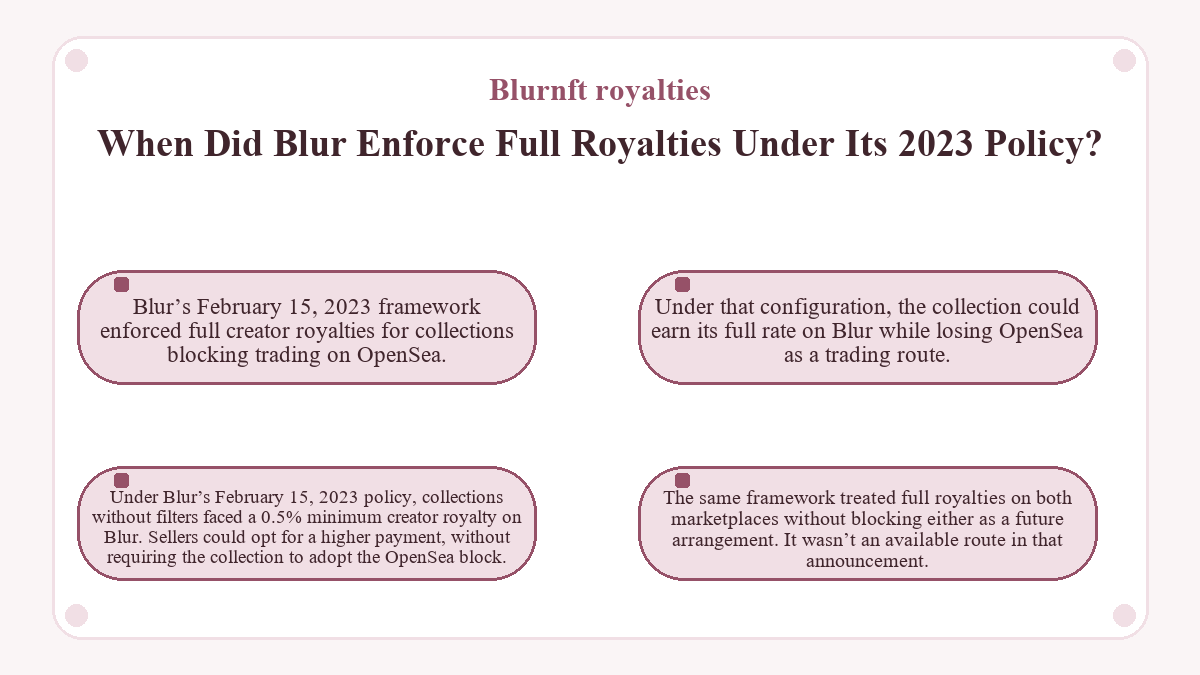
Under Blur’s February 15, 2023 policy, collections without filters faced a 0.5% minimum creator royalty on Blur. Sellers could opt for a higher payment, without requiring the collection to adopt the OpenSea block.
The same framework treated full royalties on both marketplaces without blocking either as a future arrangement. It wasn’t an available route in that announcement.
Royalty Signals and Transfer Restrictions
ERC-2981 supplies royalty information for an NFT without making its transfer conditional on payment. ERC-2981 returns a royalty recipient and an amount for a specified token and sale price. The marketplace still needs a mechanism to distribute those funds. A transfer restriction addresses a different function: whether a particular operator may move the NFT. Signaling a requested payment and restricting transfer access provide different controls over a resale.
Aggregated Listings and Settlement Rules
An aggregated listing retains the order terms the executing marketplace contract accepts. Bringing listings into Blur’s interface doesn’t replace their settlement contracts with one universal royalty policy. A native listing and an order originating elsewhere can carry different payment arrangements for the same collection shown in Blur’s interface.
The sale price, creator payment and other settlement fees describe separate parts of those arrangements. An asking price alone can’t establish the creator’s eventual receipt. The order’s originating marketplace and its execution mechanism affect which fee terms apply. A royalty preference shown beside the collection also doesn’t demonstrate the payment an external order will execute.
How Does a Collection Filter Affect Trading Access?
A collection filter affects the transfer operators its contract restricts, so its impact depends on the route attempting to move the NFT. In Blur’s February 2023 framework, blocking Blur disabled bidding without disabling listing and trading.
For ERC-721 NFTs, an operator is an address approved to move a holder’s tokens. Collection code can add transfer conditions beyond those approvals. Restricting an operator changes access to the NFT; it doesn’t itself compute a royalty payment. The blocked contracts and the collection’s implementation determine the restriction’s reach.
Reconciling a Lower Creator Payment
In a hypothetical completed resale, the creator receives less than the collection’s displayed preference. The sale’s executed price and fee terms distinguish a lower payable rate from a misread payment. Reconciliation begins with the completed sale, keeping the NFT and its designated royalty recipient consistent throughout the comparison.
- Confirm the NFT sale completed; a pending transaction hasn’t established a creator payment.
- Use the executed sale price and payment unit as the calculation basis.
- Identify the royalty rate and recipient included in that sale’s fee terms.
- Separate creator transfers from protocol fees and the transaction sender’s gas expense.
- Match the calculated creator amount against the recipient’s payment in the settled transaction.
If the transfer matches the order’s lower rate, the difference comes from requested and payable royalties. If it doesn’t, the recipient, fee interpretation or transaction decoding needs clarification. The recorded transfer provides a check independent of the displayed estimate. Changing a collection setting doesn’t rewrite a fee payment an earlier sale already executed.
Operator Filters and Later Enforcement Models
The original operator-filter rivalry describes a historical enforcement arrangement. OpenSea stopped using its Operator Filter to block marketplaces on August 31, 2023. The February comparison therefore doesn’t describe an unchanging set of restrictions across marketplaces. Collection code, marketplace policy and settlement support can change independently, so a dated blocklist diagram can’t establish today’s compatible sale routes.
OpenSea’s January 20, 2026 creator-earnings policy describes enforcement for compatible ERC721-C or ERC1155-C collections when their owners enable it. Seaport v1.6 hooks support that enforcement model by checking transfer conditions. This is a separate implementation from Blur’s historical collection-filter policy. Under that enforcement method, the policy limits supported sales to OpenSea and marketplaces powered by LimitBreak’s Payment Processor. Enforcing earnings on another supported marketplace requires that marketplace’s specified setup.
Policy Changes and Full-Rate Eligibility
Blur’s Marketplace Committee handles royalty policy alongside marketplace-contract upgrades. Protocol fee governance addresses a separate payment category. On November 11, 2024, BIP-1 proposed removing enforced creator royalties and adding a 0.5% protocol fee. That percentage described a proposed protocol charge, with a different beneficiary from a collection royalty. The proposal alone doesn’t establish an implemented fee schedule.
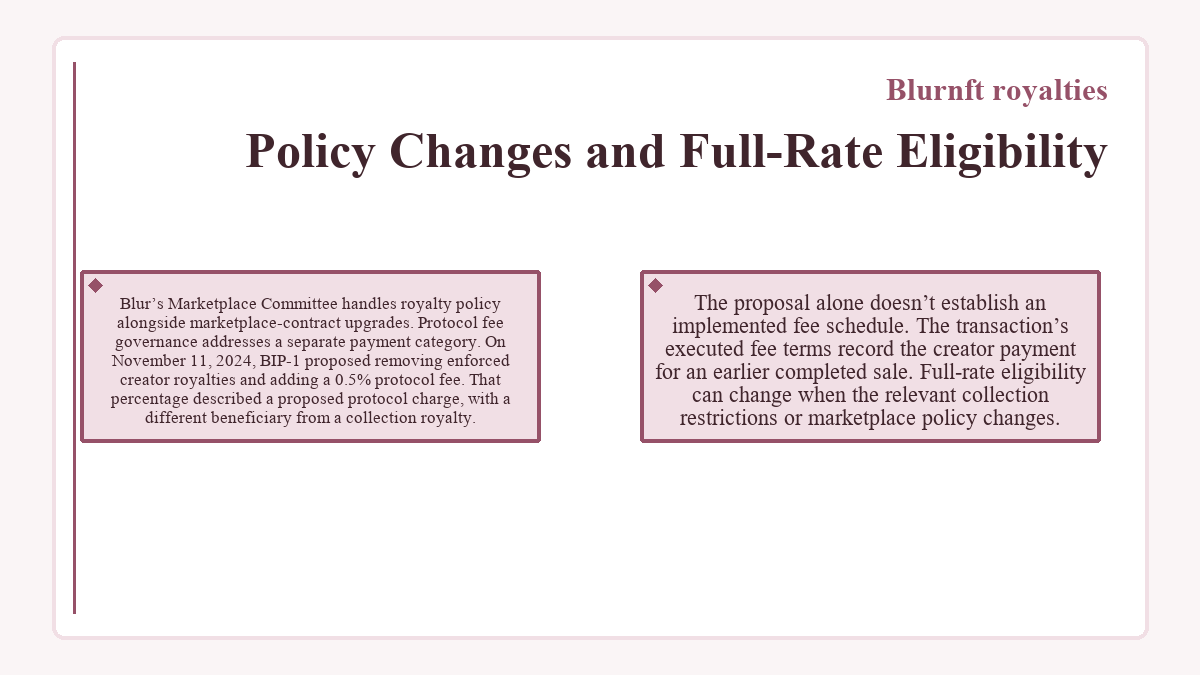
The transaction’s executed fee terms record the creator payment for an earlier completed sale. Full-rate eligibility can change when the relevant collection restrictions or marketplace policy changes.
Blurnft royalties: quick answers
Do Creator Royalties Apply When I Move an NFT Between My Own Wallets?
ERC-2981 doesn’t automatically charge royalties on a transfer between your own wallets. A transfer needn’t represent a sale, and the royalty interface reports payment information without collecting funds. Any additional transfer restriction comes from the collection’s contract, so a wallet move and a marketplace resale can have different conditions.
Can a Royalty Recipient Differ From the NFT’s Original Minter?
A royalty recipient can differ from the NFT’s original minter. The sale’s creator-fee terms identify the receiving address, which can belong to a creator, rights holder or receiving contract. ERC-2981 also reports a recipient separately from token ownership. Minting history alone doesn’t identify the beneficiary of a particular resale payment.
Will a Reverted Blurnft Sale Pay Its Creator Royalty?
A reverted sale doesn’t complete the creator payment within that reverted execution. A submitted transaction or attempted purchase therefore doesn’t establish received royalty income. If a transaction reverts, its reverted asset and payment changes don’t persist, although execution can still consume gas. An earlier successful sale remains separate.
Why Can a Royalty Calculation Differ Slightly From the Settled Amount?
Royalty calculations can leave fractional remainders when contracts express payment amounts in integer base units. ERC-2981 permits rounding up or down for those remainders. The settlement implementation’s arithmetic determines the final amount, so a small rounding difference needs separate treatment from a lower royalty percentage or an incorrect recipient.
Is One Creator Royalty Rate Required for Every NFT in a Collection?
A collection can provide token-specific royalty information if its contract supports it. Some ERC-2981 implementations let a token’s setting override the collection default. That flexibility doesn’t establish how every marketplace uses those settings. The applicable sale terms still determine the royalty amount the exchange actually distributes.