 Blurnft
Blurnft bidding uses Bid Pool ETH to fund NFT purchase offers
Blurnft bidding uses deposited ETH to fund NFT purchase offers through the Bid Pool. A collection bid applies across eligible NFTs in that collection; a trait bid narrows the eligible items. Sellers can accept valid offers, and the purchase draws from the bidder’s pool balance. The same balance can support bids across collections while sufficient funds remain.
Price and quantity determine the purchase commitment. Eligibility determines which NFTs can fill it. Funding, signed authorization and an executed transfer are separate parts of that commitment, so an open bid doesn’t establish ownership.
The short version: Shared Bid Pool funding supports offers across collections, but each completed purchase reduces the ETH available for other bids.
Bid Pool Balance and Buying Power
The Bid Pool’s ETH balance supplies the funds an accepted purchase bid spends. Depositing ETH credits the depositor’s recorded balance within the pool contract. ETH remaining in the wallet belongs to a different balance, so it doesn’t automatically cover a pool-funded offer. The pool records funds separately for each depositing address. Its total ETH holdings include other users’ deposits; that total doesn’t describe your own purchasing power.
Unused funds remain in the pool until a withdrawal or an authorized transfer changes the address’s balance.
Signed Offers and Exchange Settlement
A bid’s signature authorizes a purchase under its stated terms. Exchange V2 ties the order to its maker and collection, along with expiration and quantity data. Its EIP-712 signature format binds the authorization to the relevant chain and exchange contract. Creating that signature doesn’t execute the NFT transfer. The exchange validates the authorization when someone attempts to take the bid, alongside the offer’s other requirements.
A successful fill transfers the eligible NFT to the bidder and debits the bidder’s pool balance. In Exchange V2’s pool-funded bid settlement, the seller receives proceeds as a pool balance credit. Remaining unfilled quantity stays subject to the order’s validity conditions. A batch transaction can include several proposed fills, and some NFT transfers can fail while others succeed. The transaction’s overall success therefore doesn’t establish completion of every proposed fill.
How Do Collection Bids Differ From Trait Bids?
Collection bids cover eligible items across a collection, while trait bids restrict acceptance to NFTs with the selected trait. That scope determines what the bidder agrees to acquire at the bid price. A collection offer doesn’t require the seller to supply the rarest item or the NFT the buyer happens to prefer. Sellers choose which eligible item they sell into the offer. A trait bid reduces that choice to the matching subset, although several NFTs may share the trait.
Trait-bid execution uses an oracle to check the offered NFT’s relevant trait in real time.
The trait check concerns the item at validation time. A collection can later change metadata it controls, including traits held on a centralized server. The check doesn’t freeze those future attributes. Trait floors can also have less liquidity and greater volatility than collection floors. A trait premium therefore prices a particular attribute within a narrower market. The bidder still faces the possibility of acquiring an NFT whose later attributes or resale value differ from expectations.
Price, Quantity and Total Exposure
The bid price states payment per NFT, while the quantity caps how many eligible purchases the offer can accept. Maximum base commitment equals price multiplied by permitted quantity; actual spending follows the quantity filled. Applicable buyer-side fees add to the debit. Exchange V2 records filled amounts and checks remaining capacity before allowing further fills. For ERC-721 bids, each individual NFT transfer takes one item, even when the offer permits several fills. Quantity measures purchase capacity, so it doesn’t identify particular token IDs. Increasing it expands the potential acquisition commitment at the stated price.
Can the Same ETH Back Bids Across Collections?
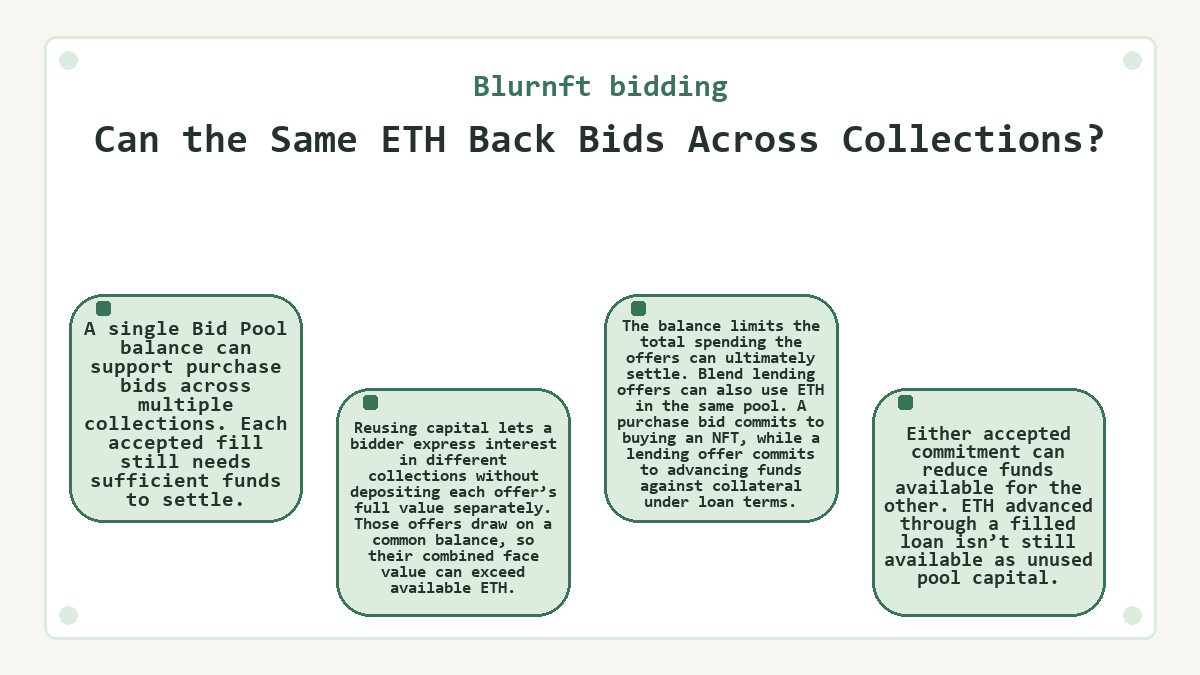
A single Bid Pool balance can support purchase bids across multiple collections. Each accepted fill still needs sufficient funds to settle. Reusing capital lets a bidder express interest in different collections without depositing each offer’s full value separately. Those offers draw on a common balance, so their combined face value can exceed available ETH. The balance limits the total spending the offers can ultimately settle.
Blend lending offers can also use ETH in the same pool. A purchase bid commits to buying an NFT, while a lending offer commits to advancing funds against collateral under loan terms. Either accepted commitment can reduce funds available for the other. ETH advanced through a filled loan isn’t still available as unused pool capital.
A Shared Balance Behind Two Purchase Offers
Two individually funded bids can exceed what one balance can purchase in total. In this hypothetical example, the bidder wants either of two eligible collection purchases. The pool holds 0.237 ETH. One offer bids 0.14 ETH for one NFT, and the other bids 0.16 ETH for one NFT in a different collection. Assume both orders remain valid, no maker fee adds to either purchase debit and no other transfers affect the balance.
Each offer fits individually within 0.237 ETH, so the shared pool can back either purchase. Filling both would require 0.30 ETH. The pool doesn’t reserve 0.14 ETH for one collection plus another 0.16 ETH for the other. If the first offer fills, its purchase debits 0.14 ETH and leaves 0.097 ETH. The second offer then lacks sufficient funds to settle at 0.16 ETH.
The funding condition changes after the first fill, even though the second offer’s stated price hasn’t changed. Additional deposits could restore the missing funding. Whether that offer can then fill also depends on its remaining quantity, expiration and cancellation status.
Funding Transactions and Bid Costs
Deposits and withdrawals are Ethereum transactions, so their gas cost follows the work executed and the applicable network fee. Off-chain order signing doesn’t itself spend transaction gas. A seller taking a bid submits the settlement transaction, which has its own gas cost. Trade fees and royalties belong to the sale’s payment terms. In Exchange V2, the bid maker’s fee adds to the bidder’s purchase debit. Protocol and taker fees reduce the seller’s proceeds from the bid price. A quoted offer, total buyer debit and seller credit can therefore differ. ETH kept in the wallet covers the bidder’s own transaction gas separately from pool funding.
Cancellation and Pool Withdrawals
Canceling a bid changes purchase authorization; withdrawing ETH changes the pool balance. An individual order cancellation can leave funds available for other bids. A withdrawal reduces the balance all pool-funded commitments use. Neither operation reverses an already completed purchase. Choosing between them depends on whether the goal is to stop a particular offer or remove unused capital. A withdrawal can also leave a different open offer without enough funding, even when its signed terms remain unchanged.
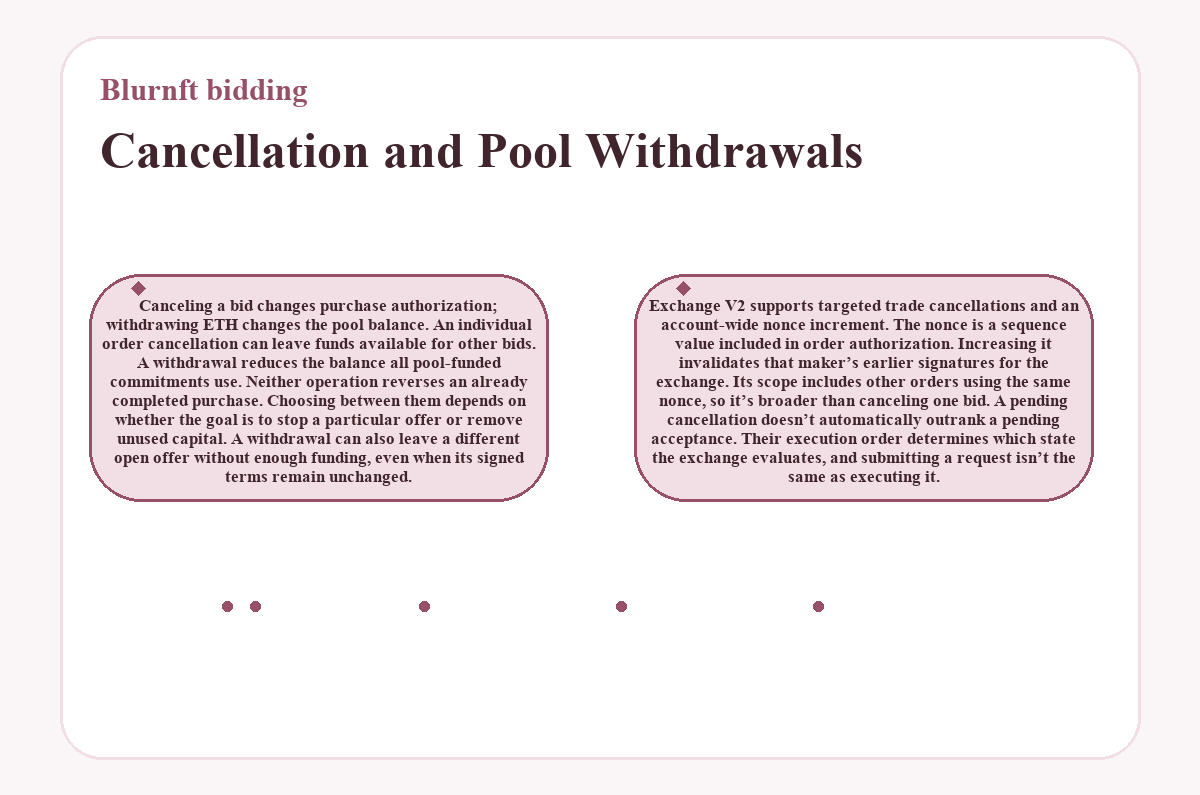
Exchange V2 supports targeted trade cancellations and an account-wide nonce increment. The nonce is a sequence value included in order authorization. Increasing it invalidates that maker’s earlier signatures for the exchange. Its scope includes other orders using the same nonce, so it’s broader than canceling one bid. A pending cancellation doesn’t automatically outrank a pending acceptance. Their execution order determines which state the exchange evaluates, and submitting a request isn’t the same as executing it.
Expiration and Other Validity Conditions
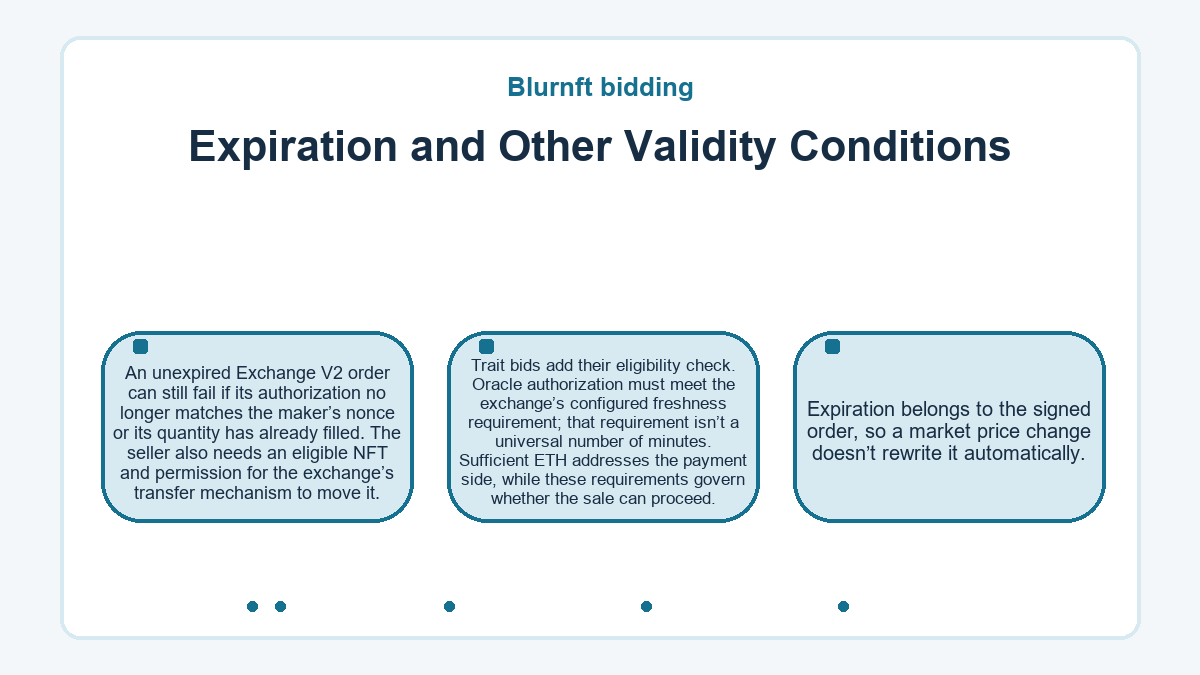
An unexpired Exchange V2 order can still fail if its authorization no longer matches the maker’s nonce or its quantity has already filled. The seller also needs an eligible NFT and permission for the exchange’s transfer mechanism to move it. Trait bids add their eligibility check. Oracle authorization must meet the exchange’s configured freshness requirement; that requirement isn’t a universal number of minutes. Sufficient ETH addresses the payment side, while these requirements govern whether the sale can proceed. Expiration belongs to the signed order, so a market price change doesn’t rewrite it automatically.
Bid Walls, Floor Prices and Fill Risk
A bid wall groups buying offers by price and size, showing where displayed demand sits. The floor price describes the lowest asking price, while a purchase bid states what a buyer offers. Their difference doesn’t establish a resale profit. A seller can accept an eligible bid when its price suits them, including after market conditions have changed. The bid price remains the buyer’s commitment until the offer changes, expires or becomes invalid. A falling floor can therefore leave an unchanged offer above newer asking prices.
Displayed depth can shrink as makers cancel offers or spend their pool balances. A top bid can disappear before a resale reaches settlement. Trait orders also apply only to matching NFTs, so their demand shouldn’t be read as collection-wide buying capacity. Completed sales show actual trading prices; open listings and bids show intentions.
How Do Reward Points Relate to Filled Bids?
Reward points have followed campaign rules for active offers, separate from the ETH spent when a purchase fills. In Season 4, a bid earned points while active; acceptance didn’t add a separate reward. Season 4’s published timetable set its end in June 2025. Only selected collections were eligible for trait-bid points in Season 4. Reward eligibility and allocations belong to their own season; a past campaign’s points aren’t a standing payment promise. A purchase leaves the bidder holding an NFT at the agreed cost. Points and an eventual token distribution aren’t a fixed return on that purchase.
Questions people ask about Blurnft bidding
Will My Purchase Bid Remain Executable After I Close the Browser?
Closing the browser doesn’t revoke a signed purchase bid. An authorized offer can still execute if it hasn’t expired, retains unfilled quantity and has sufficient pool funding. The seller’s transfer must also satisfy the exchange’s requirements. Ending a browser session changes access to the interface; canceling an order changes the authorization a seller can use.
What Happens to Unused Pool ETH When a Bid Expires?
An unfilled bid’s expiration doesn’t automatically withdraw its unused ETH from the Bid Pool. Expiration ends that order’s validity, while the pool records the deposited balance separately. Funds the expired bid hasn’t spent can remain available for other valid commitments. Moving unused ETH back to the wallet requires a withdrawal, which has its own transaction cost.
Who Can Move the ETH Backing My Purchase Bids?
The pool’s ordinary withdrawal method lets an address withdraw its own recorded balance. Authorized marketplace and lending contracts can also move pool funds through their permitted operations. An unrelated wallet can’t claim your deposit through the ordinary withdrawal method. This access restriction doesn’t prevent a purchase you authorized from spending the ETH backing its valid bid.
Does a Failed Attempt to Take My Bid Consume Its Quantity?
A reverted Exchange V2 bid-fill transaction doesn’t consume purchase quantity. The reverted transaction rolls back its order-state changes. A successful batch can still include failed NFT transfers, and only completed transfers count toward filled quantity. Other successful fills or cancellations can change the order separately, so an earlier failed attempt doesn’t establish its present remaining capacity.
Must I Own an NFT Before Placing a Blurnft Purchase Bid?
An ETH-funded purchase bid doesn’t require the bidder to own an NFT beforehand. The seller supplies the eligible NFT when the trade executes. The bidder supplies pool funding and authorizes the offer’s terms. Holding another NFT doesn’t replace that ETH balance, and a purchase bid doesn’t pledge existing NFTs as loan collateral.