 Blurnft
Blurnft NFT Collateral Risk and Loan Terms
Blurnft loans through Blend tie available credit and borrowing rates to lenders’ assessment of NFT collateral risk. A lender offers an amount and a rate for a specified collection. Those terms define the initial loan; refinancing can change its cost. Borrowers risk collateral loss if refinancing fails and the loan remains unpaid at the auction deadline.
An NFT’s asking price, an available purchase bid and a borrowing offer describe different commitments. Borrowers need to compare the amount advanced with the debt they’ll owe and their ability to repay if lending conditions worsen.
Bottom line: A low loan rate leaves collateral risk intact when the lender requests refinancing and replacement credit becomes unavailable.
Collateral Risk Behind a Lender’s Offer
A lender’s offer reflects the capital they’re willing to advance against the NFT and the interest they require for taking that exposure. If the borrower doesn’t repay, the lender may eventually receive the collateral. Its potential sale value therefore matters alongside the interest rate. A displayed valuation offers little protection if buyers won’t actually pay that amount.
Lenders can respond to uncertain collateral by offering less credit, asking for more interest or declining to lend. Competition between lenders also influences available terms. A larger advance increases the debt replacement funding would need to cover, even when its initial rate is low.
Loan Credit, Purchase Bids and Asking Prices
A Blend lending offer supplies ETH-denominated credit against eligible collateral, while a purchase bid offers payment for acquiring an NFT. Accepting the lending offer creates debt. Accepting a valid purchase bid transfers the NFT under the sale’s terms. An asking price expresses what a seller wants, without establishing either available borrowing capacity or settled sale proceeds.
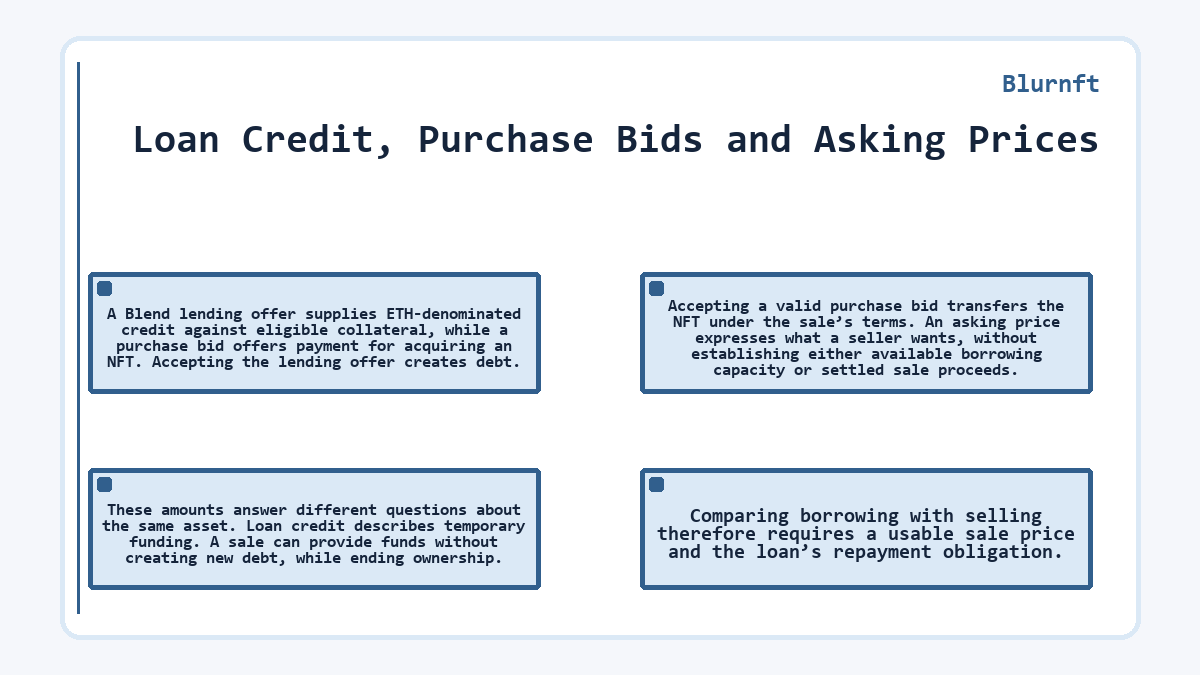
These amounts answer different questions about the same asset. Loan credit describes temporary funding. A sale can provide funds without creating new debt, while ending ownership. Comparing borrowing with selling therefore requires a usable sale price and the loan’s repayment obligation.
Does a Higher Floor Price Increase Borrowing Capacity?
A higher floor price may influence new lending offers, but it doesn’t automatically increase an existing Blend loan or guarantee additional credit. Lenders still choose the terms they’re willing to fund. The core model doesn’t use an NFT price oracle to automatically recalculate the loan’s principal when a collection price changes.
Debt and Valuation Inputs
The Outstanding Loan Balance
A loan-to-value ratio divides the loan balance by the collateral value used in the comparison. Both amounts need the same currency basis. Interest can increase the balance even when the NFT’s estimated value stays unchanged. The original amount borrowed and today’s repayment amount can therefore produce different ratios.
The Collateral Value Used
A collection floor, an individual asking price and an executable offer aren’t interchangeable valuations. An asking price doesn’t establish a buyer’s willingness to pay. Any calculated ratio inherits the limits of its valuation input; it doesn’t become a protocol liquidation threshold simply because the arithmetic produces a percentage.
Interest Accrual and the Repayment Amount
A Blend repayment amount reflects the principal and accrued interest, so the initial advance alone doesn’t describe the eventual settlement cost. Blend computes accrued debt from the loan amount, its stored interest rate and elapsed time. The published Blend debt calculation uses continuous compounding. A flat percentage charge for a borrowing period therefore won’t reproduce that calculation.
A positive rate increases debt as time passes. A zero interest rate removes that interest component while it remains in force, without removing the collateral obligation.
An annualized percentage and a repayment amount also have different units. The percentage describes a rate over time; the repayment amount states how much the active loan owes at a particular point.
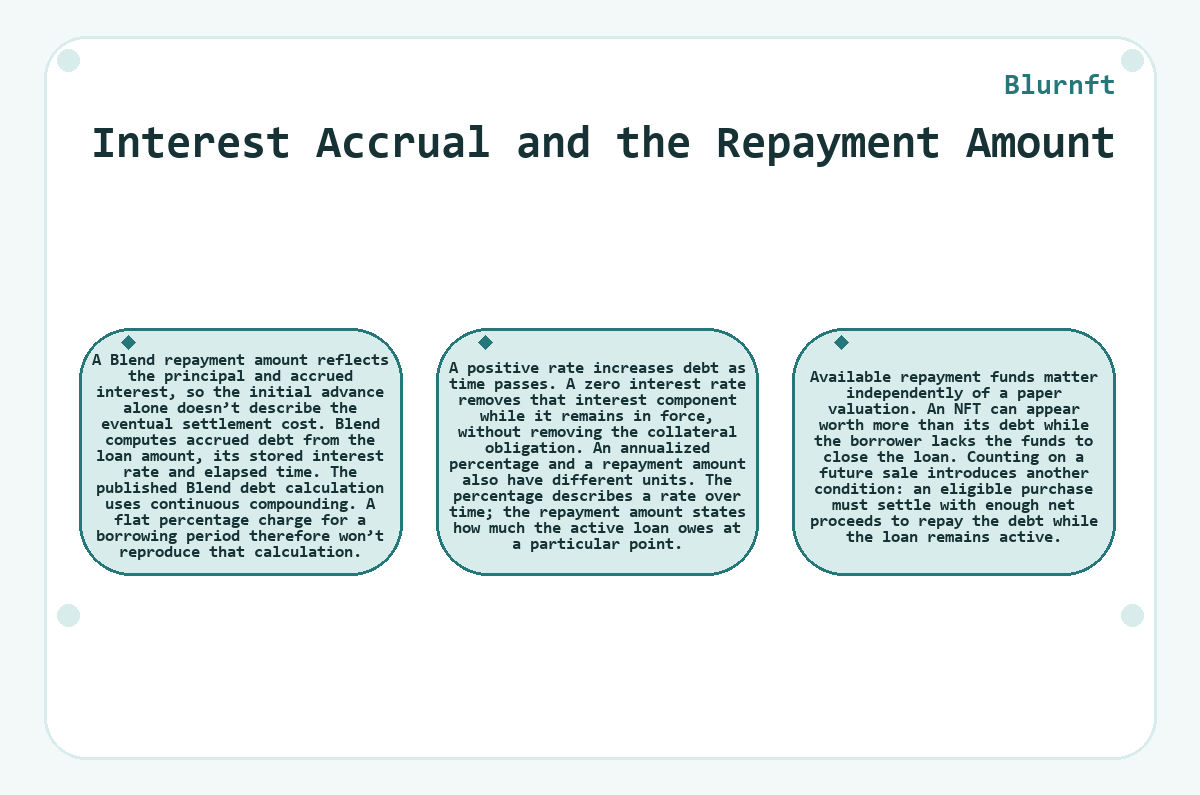
Available repayment funds matter independently of a paper valuation. An NFT can appear worth more than its debt while the borrower lacks the funds to close the loan. Counting on a future sale introduces another condition: an eligible purchase must settle with enough net proceeds to repay the debt while the loan remains active.
Can a Fixed-Rate Loan Become More Expensive?
A fixed-rate Blend loan can become more expensive after refinancing replaces it with a loan carrying a higher interest rate. The active loan’s rate doesn’t automatically follow every change in marketplace prices. Its cost can change through replacement terms, and a lender’s decision to exit can create the need for that replacement.
Borrower-initiated refinancing and a lender’s exit aren’t the same decision. A borrower can seek different terms through a compatible offer. A lender can seek repayment through refinancing even when the borrower would prefer to continue unchanged. The absence of a scheduled maturity doesn’t provide a commitment to lend forever at the original rate.
Direct lender-arranged refinancing has different limits from an auction: the published contract requires a replacement rate no higher than the existing rate and the same auction duration as the active loan. Auction refinancing can admit higher rates as its ceiling rises. A borrower arranging their own replacement accepts the new offer’s terms.
Refinancing Auctions and Collateral Loss
A Blend refinancing auction seeks replacement funding for an existing loan, exposing the borrower to the terms other lenders will accept. A replacement lender pays off the outgoing lender and takes over the debt position. The auction concerns financing secured by the NFT; it doesn’t promise to sell the NFT at its displayed market value.
During the Active Auction
The auction’s permitted refinancing rate rises over its course, allowing replacement funding at progressively higher rates. The rising ceiling concerns possible replacement terms. The existing debt continues accruing under its stored rate until a successful refinance changes the loan.
The loan’s auction duration controls the refinancing interval. In the published block-based implementation, that duration counts blocks, so a clock estimate isn’t the exact contract boundary. Repayment or an eligible refinance must complete while the loan remains active. A pending transaction doesn’t establish either outcome.
After the Loan Defaults
If a Blend refinancing auction ends with the debt unpaid, the existing lender can claim the pledged NFT. The lender must execute the collateral claim; an auction ending and an ownership transfer are distinct events. A difference between estimated NFT value and outstanding debt doesn’t itself entitle the borrower to a surplus payment from that claim.
Existing NFT Collateral and Financed Purchases
Borrowing against an NFT already held releases credit from an existing asset, while a financed purchase uses borrowing toward acquiring the collateral. When the purchase price exceeds the loan amount, the buyer supplies the difference. Both arrangements expose the pledged NFT to the loan’s terms. A smaller purchase contribution doesn’t establish a smaller repayment obligation; the borrowed amount and accrued interest govern the debt.
Conditions for a Lower-Rate Refinance
Borrower-initiated refinancing of an active Blend loan with a lower-rate replacement offer requires reconciling the new loan amount with the debt being settled. The intended outcome is a replacement loan charging less future interest, with the same NFT still pledged. A lower quoted rate alone doesn’t establish that outcome.
- Match the replacement offer’s collection to the pledged NFT and its amount limits to the proposed loan.
- Compare the replacement interest rate and auction duration with the active loan’s terms.
- Confirm the offer remains valid and its lender can fund the replacement.
- Provide any repayment shortfall through your Blur Pool balance before submitting borrower-initiated refinancing.
- After confirmed refinancing, reconcile the recorded lender, loan amount and rate with the accepted terms.
A completed refinance settles the outgoing lender’s debt and updates the loan without releasing the NFT. The settlement includes accrued interest even if the replacement loan carries a lower rate. The lower rate applies while the replacement terms remain in force; another refinancing event can change that borrowing cost again.
Network Costs and Sale Proceeds
Ethereum transaction fees add to the expense of on-chain loan actions, including repayment and refinancing. Gas depends on the work the transaction performs and the applicable gas price. A small interest saving can therefore leave a refinancing transaction uneconomic once execution costs enter the comparison. The interest rate doesn’t incorporate that separate network charge.
Lending protocol fees also fall within governance’s powers, so historical fee arrangements don’t establish permanent pricing. When a pledged NFT sale repays a loan, the gross sale price isn’t the borrower’s available surplus. In Blend’s supported sale-to-repay flows, proceeds after sale charges must cover the accrued debt. Creator royalties, where the sale includes them, can reduce those net proceeds. Only the remainder belongs to the borrower.
When Does Selling the NFT Avoid Refinancing Risk?
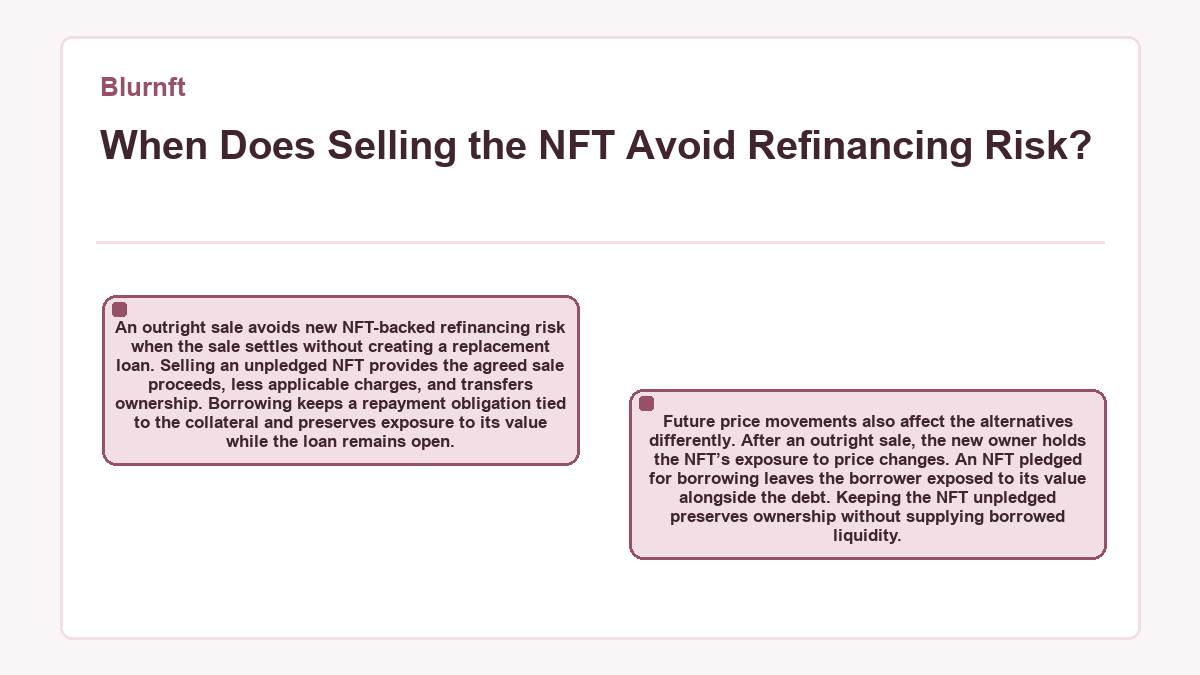
An outright sale avoids new NFT-backed refinancing risk when the sale settles without creating a replacement loan. Selling an unpledged NFT provides the agreed sale proceeds, less applicable charges, and transfers ownership. Borrowing keeps a repayment obligation tied to the collateral and preserves exposure to its value while the loan remains open.
Future price movements also affect the alternatives differently. After an outright sale, the new owner holds the NFT’s exposure to price changes. An NFT pledged for borrowing leaves the borrower exposed to its value alongside the debt. Keeping the NFT unpledged preserves ownership without supplying borrowed liquidity.
Blurnft: what people ask
Does a Blurnft Loan offer’s Expiration Set the loan’s Maturity?
A lending offer’s expiration limits when someone can accept that offer; it doesn’t give an accepted perpetual Blend loan a matching maturity date. An active loan instead has its recorded terms and, if the lender starts refinancing, an auction deadline. An expired offer and a defaulted loan describe different states.
Why doesn’t an NFT’s Rarity Automatically Increase Its Blend Loan Limit?
A collection-wide lending offer doesn’t automatically appraise an individual NFT’s rarity. Its amount limits reflect the terms the lender offers for that collection. A rare trait creates additional borrowing capacity only if a lender supplies applicable terms recognizing that value; a rarity ranking alone doesn’t change an existing loan.
Can I Make a Partial Repayment Without Replacing My Blend Loan?
Blend’s standard repayment operation settles the full accrued debt and closes the loan. It doesn’t leave a smaller active balance. Borrower-initiated refinancing can establish a smaller replacement loan when a compatible offer exists and the borrower supplies the difference needed to repay the outgoing lender.
Will Refinancing Always Put Fresh Borrowed Funds in My Wallet?
Refinancing can settle existing debt without providing any additional funds to the borrower. In borrower-initiated refinancing, replacement credit first covers the outgoing lender’s debt. Only credit exceeding that debt produces a surplus credited to the borrower’s Blur Pool balance; a shortfall requires borrower funds. Blend’s auction refinancing sets the replacement loan amount to the accrued debt.
Are Other NFTs in My Wallet Collateral for the Same Blend Loan?
An individual Blend loan identifies its pledged NFT by collection and token ID, so other NFTs don’t automatically secure that loan. A collection-wide transfer approval concerns permission to move tokens, which is separate from the collateral recorded for a particular debt. Broader approval doesn’t turn every token into that loan’s collateral.
Do I Need BLUR Tokens to Cover a Blend loan’s Principal?
Blend’s loan principal is ETH-denominated, while BLUR is the governance token. BLUR holdings don’t substitute for the repayment funds the lending mechanism requires. Blend transfers loan funds through ETH balances in the Blur Pool. Gas requires ETH in the transaction sender’s wallet.